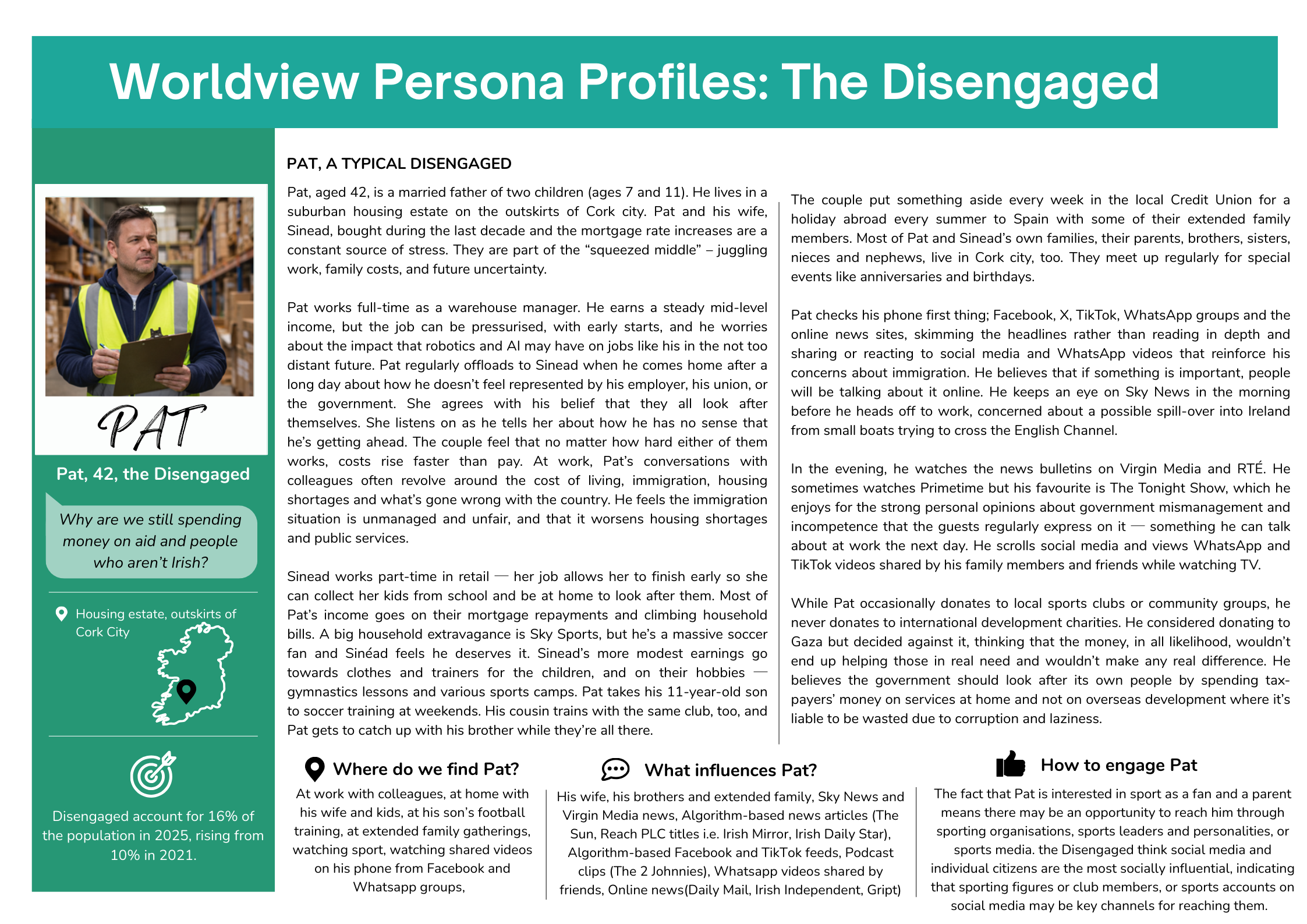
Meet Pat, a typical Disengaged
Pat, aged 42, is a married father of two children (ages 7 and 11). He lives in a suburban housing estate on the outskirts of Cork city. Pat and his wife, Sinead, bought during the last decade and the mortgage rate increases are a constant source of stress. They are part of the “squeezed middle” – juggling work, family costs, and future uncertainty.
Pat works full-time as a warehouse manager. He earns a steady mid-level income, but the job can be pressurised, with early starts, and he worries about the impact that robotics and AI may have on jobs like his in the not too distant future. Pat regularly offloads to Sinead when he comes home after a long day about how he doesn’t feel represented by his employer, his union, or the government. She agrees with his belief that they all look after themselves. She listens on as he tells her about how he has no sense that he’s getting ahead. The couple feel that no matter how hard either of them works, costs rise faster than pay.
Sinead works part-time in retail ─ her job allows her to finish early so she can collect her kids from school and be at home to look after them. Most of Pat’s income goes on their mortgage repayments and climbing household bills. A big household extravagance is Sky Sports, but he’s a massive soccer fan and Sinéad feels he deserves it. Sinead’s more modest earnings go towards clothes and trainers for the children, and on their hobbies ─ gymnastics lessons and various sports camps. Pat takes his 11-year-old son to soccer training at weekends. His cousin trains with the same club, too, and Pat gets to catch up with his brother while they’re all there.
The couple put something aside every week in the local Credit Union for a holiday abroad every summer to Spain with some of their extended family members. Most of Pat and Sinead’s own families, their parents, brothers, sisters, nieces and nephews, live in Cork city, too. They meet up regularly for special events like anniversaries and birthdays.
Pat checks his phone first thing; Facebook, X, TikTok, WhatsApp groups and the online news sites, skimming the headlines rather than reading in depth and sharing or reacting to social media and WhatsApp videos that reinforce his concerns about immigration. He believes that if something is important, people will be talking about it online. He keeps an eye on Sky News in the morning before he heads off to work, concerned about a possible spill-over into Ireland from small boats trying to cross the English Channel.
At work, Pat’s conversations with colleagues often revolve around the cost of living, immigration, housing shortages and what’s gone wrong with the country. He feels the immigration situation is unmanaged and unfair, and that it worsens housing shortages and public services.
In the evening, he watches the news bulletins on Virgin Media and RTÉ. He sometimes watches Primetime but his favourite is The Tonight Show, which he enjoys for the strong personal opinions about government mismanagement and incompetence that the guests regularly express on it ─ something he can talk about at work the next day. He scrolls social media and views WhatsApp and TikTok videos shared by his family members and friends while watching TV.
While Pat occasionally donates to local sports clubs or community groups, he never donates to international development charities. He considered donating to Gaza but decided against it, thinking that the money, in all likelihood, wouldn’t end up helping those in real need and wouldn’t make any real difference. He believes the government should look after its own people by spending tax-payers’ money on services at home and not on overseas development where it’s liable to be wasted due to corruption and laziness.
Quick Look:
Where do we find Pat?
At work with colleagues, in the car, at home with his wife and kids, at his son’s football training, at extended family gatherings, watching sport, watching shared videos on his phone from Facebook and Whatsapp groups.
What influences Pat?
His wife, his brothers and extended family, Sky News and Virgin Media news, Algorithm-based news articles (The Sun, Reach PLC titles i.e. Irish Mirror, Irish Daily Star), Algorithm-based Facebook and TikTok feeds, Podcast clips (The 2 Johnnies), Whatsapp videos shared by friends, Online news (Daily Mail, Irish Independent, Gript).
Avenues for engagement
The fact that Pat is interested in sport as a fan and a parent means there may be an opportunity to reach him through sporting organisations, sports leaders and personalities, or sports media. The Disengaged think social media and individual citizens are the most socially influential, indicating that sporting figures or club members, or sports accounts on social media may be key channels for reaching them.
Messaging Recommendations to reach Disengaged like Pat
The Disengaged like Pat are being influenced by more siloed and curated forms of information and news (Family members, Friends, TV news, Social media sites and platforms (Facebook, X, etc)). The fact that Pat is interested in sport as a fan and a parent means there may be an opportunity to reach him through sporting organisations, sports leaders and personalities, or sports media. According to the Worldview 2025 findings, in terms of who or what is influential in bringing about social change, the Disengaged rank social media and individual citizens in joint first place, indicating that sporting figures or club members, or sports accounts on social media may be key channels for reaching them.
Pat may be subconsciously asking: “Why should I care when nobody seems to care about people like me?” Pat’s disengagement is driven by:
- Economic pressure (“I’m barely coping myself”)
- Distrust of government, unions, elites and institutions
- Perceived unfairness (“Others are getting help while I’m falling behind”)
- Low belief in impact (“The money won’t reach the right people”)
We should frame overseas development through: Fairness; Control; Proof; Straight talking; “Every euro is tracked”; “Independent audits”; “Money goes directly to…”; “No waste, no middlemen”. Acknowledge domestic pressures; Demonstrate strict accountability; Show how well-run aid helps ordinary families without making things worse at home; Avoid activist language; Avoid guilt (“we all must do our part”); Avoid moral superiority.
Explore Pat’s narrative more below.