

Executive Summary
Background and purpose
Dóchas commissioned a qualitative study to explore how the local partners of our member organisations define, experience, and measure success in locally led development (LLD). The study was conducted in Ethiopia, Kenya, and Uganda and engaged 28 local civil society organisations (CSOs), community-based organisations (CBOs), cooperatives, and women-led organisations partnering with 8 Dóchas member organisations.
The primary aim was to generate evidence on what local partners themselves consider to be meaningful indicators of progress towards LLD, and to use those perspectives to inform discussion on more inclusive and contextually grounded monitoring, evaluation, accountability, and learning (MEAL) frameworks across the Dóchas membership. This study forms part of Dóchas members’ broader commitment to advancing equitable partnerships and supporting the transition towards locally led development cooperation.
Dóchas commissioned the Vashi Impact Group (VIG) to undertake this research. The findings presented in this report reflect the perspectives and beliefs of participating local partners. They are not intended as a definitive or statistically representative assessment of progress across all Dóchas member partnerships.
The main purpose of the study is to enable and support members and other stakeholders to further strengthen efforts in moving to locally led models of development.
Key Findings
Findings reflect the perceptions and lived experiences of local partners. These perspectives are presented as important evidence in their own right – whether or not they fully align with the experience of member organisations or other sector stakeholders. Understanding how partners see the partnership, and more general approaches to development, is in itself a critical step towards more equitable collaboration.
Measurement of progress towards LLD
Dóchas member organisations demonstrate strong and growing commitment to LLD, increasingly framing it as a broader shift in power, decision-making, ownership, and accountability rather than simply a programming modality. Measurement approaches are strengthening, with a number of member organisations tracking various elements and levels of participation, partnership quality, organisational strengthening, accountability, and community engagement. How much, and what, is measured in relation to the move to more locally led models of development varies significantly across participating members. Measurement systems remain stronger in capturing programme performance and partnership processes than in assessing deeper transformational shifts related to power redistribution, local autonomy, and decision-making authority.
From the perspective of local partners, measurement practices overall remain heavily shaped by donor and member organisation reporting requirements. Local partners are primarily positioned as generators of programme-level evidence within externally defined MEAL systems, rather than as independent designers of measurement frameworks based on local context and systems.
Power dynamics and governance
Power imbalances remain a defining feature of the development system as perceived by local partners. Authority over strategic direction, programme design, and funding allocation is largely concentrated among donors and international non-governmental organisations (INGOs). Local partners consistently distinguish between consultation and participation, and genuine leadership – they are often engaged after key decisions have already been made. Gradual shifts are evident in some long-term partnerships and consortium models, but these remain uneven and context-specific, and differ across locations and partner types.
Financing and resource mobilisation
While partners highlight areas where some progress has been made, financing structures are largely perceived as a central constraint on LLD. Local partners reference indirect funding flows, short-term project funding, delayed disbursements, rigid donor conditions, unrealistic and limiting co-funding requirements, and limited flexibility in budget utilisation and repurposing in the case of changing contexts. Financial, operational, and other risks are seen as disproportionately carried by local organisations, particularly smaller and grassroots partners.
Strategy, co-creation, and programme design
Local partners consistently emphasise the importance of being involved from the earliest stages of strategic direction, priority setting, and programme conceptualisation. While improvements in consultation and co-creation are acknowledged, priorities, strategies, and funding frameworks are still frequently developed externally by donors and INGOs before local partners are engaged. Positive examples highlighted during discussions, where co-creation has been meaningfully practised, demonstrate its effectiveness in improving relevance, acceptance, and sustainability.
Capacity strengthening
Capacity strengthening is recognised as central to LLD, but participating local partners report that existing approaches often remain training-oriented and externally defined. Meaningful capacity strengthening, from local partner perspectives, involves the promotion and enabling of increased autonomy, stronger governance systems, negotiation power, resource mobilisation capacity, and organisational resilience – not training delivery alone.
MEAL systems
MEAL systems are largely oriented towards upward accountability to donors through reporting, compliance, and predefined indicators. Local partners measure programme delivery, outputs, participation, and financial accountability within frameworks designed by donors and INGOs while dimensions more closely associated with progress on LLD – such as local agency, ownership, trust, and mutual accountability – remain weakly captured.
Recommendations summary
The findings of this research are intended for donors and INGOs, specifically the Irish Department of Foreign Affairs and Trade (DFAT Ireland) and the membership of Dóchas. While full recommendations are presented in the “Recommendations” tab, there are three main recommendations:
Develop an integrated approach to evaluating the shift to LLD, focusing on behavioural change by tracking a range of metrics along a progressive continuum
Prioritise the long-term transfer of control over resources and decision-making, rather than limiting focus to funding flows alone
Adopt an initial menu of metrics as a shared reference point to encourage an incremental move toward LLD
A sample menu is provided in the “Menu of Metrics” tab (it is also available in the PDF report, page 23).
Introduction
About Dóchas and this study
In recent years, Dóchas has increasingly positioned locally led development (LLD) at the centre of our strategic and policy engagement. This reflects wider global shifts within the development and humanitarian sector towards recognising the leadership, agency, and decision-making authority of partners in the Global South, particularly those closest to affected communities.
Across the Dóchas membership, organisations are progressively exploring how to move beyond traditional partnership models towards more equitable relationships that strengthen local ownership, leadership, accountability, and autonomy.
The study was exploratory in nature and aimed at generating grounded insights and learning rather than statistically representative findings. The findings presented reflect the perspectives and beliefs of participating local partners, whether or not those perspectives are always corroborated by member organisations or by objective measurement.
Why now?
A key driver of this momentum has been Ireland’s Civil Society Partnership for A Better World (ICSP) framework. Under the ICSP, Ireland’s Department of Foreign Affairs (DFAT Ireland) requires funded organisations to demonstrate concrete progress towards locally led approaches, particularly through Process Outcome 3, which focuses on empowering local partners to represent and deliver services to communities and people. All ten ICSP partner organisations within the Dóchas membership have developed LLD policies or pathways to guide this transition.
Other Dóchas member organisations, including both strategic and Civil Society Fund (CSF) partners, are also increasingly engaging with LLD agendas through internal reforms, partnership reviews, and efforts to strengthen accountability and local ownership.
Purpose and objectives of this study
Dóchas commissioned the Vashi Impact Group (VIG) to conduct a qualitative study with the following four objectives:
To support Dóchas members in meeting their commitments to LLD by gathering evidence on what local partners consider to be relevant indicators of success in moving to LLD models
To promote the wider shift towards LLD through the measurement of success factors as defined by local partners
To begin to understand the more transformative elements, from local partner perspectives, that indicate a power shift, and what that looks like in terms of monitoring, evaluation, accountability, and learning (MEAL)
To make recommendations to donors on LLD success factors as perceived by local partners in the Global South
Research questions
- What do local CSOs and CBOs identify as the key indicators of success in advancing LLD within their contexts?
- How do local partners perceive their roles and levels of agency, ownership, leadership, and accountability in existing development partnerships?
- What transformative changes in power dynamics and decision-making processes do local partners associate with meaningful progress towards LLD?
- How are factors such as financial sustainability, autonomy, and representation prioritised and experienced by local partners in the pursuit of LLD?
- What challenges and enablers do local partners identify in measuring and demonstrating progress towards LLD within MEAL frameworks?
- How can MEAL frameworks be adapted or developed to better capture and support locally defined success factors and priorities in the move towards LLD?
- What recommendations do local partners have for INGOs and donors to strengthen support for LLD?
How LLD is Currently Measured?
What our member organisations are measuring
Across both the interviews conducted with participating member organisations and the documentation reviewed, we found strong and growing commitment to the shift towards LLD across the Dóchas membership. There is evidence that participating member organisations increasingly frame LLD not simply as a programming modality, but as a broader shift in relationships, decision-making, accountability, and power within the development and humanitarian sector.
Organisational documents emphasised respectful partnerships, community leadership, participation, mutual accountability, and the strengthening of local systems. LLD is commonly associated, among these members, with decentralised decision-making, community ownership, and the repositioning of INGOs as facilitators and convenors rather than primary drivers of development processes.
However, member organisations are at very different stages in the move towards LLD. Some demonstrate relatively advanced efforts to formalise LLD commitments through dedicated strategies, partnership frameworks, governance arrangements, and accountability mechanisms. Others articulate LLD more broadly through organisational values and partnership principles. This variation reflects the evolving nature of LLD across the sector and the absence of standardised approaches for conceptualising and operationalising LLD commitments. It also reflects the different histories and programming modalities of member organisations.
It is important to note that how much, and what, is measured in relation to the move to more locally led models of development varies significantly across participating members. While a small number have set LLD-related benchmarks against which they report to donors, there is no consistent approach to measuring the shift to LLD. The research also reflects more of what a small number of organisations are trying to track rather than how they are tracking (the indicators).
Domains and types of indicators currently used by some member organisations
These domains represent what some members are tracking or aspiring to measure; it is not intended as a best practice recommendation but rather reflects some of the challenges and opportunities for the sector in developing MEAL for LLD. For further details, please refer to Table 1 (page 11) on the PDF report.
Local partners – tracking LLD and their role in MEAL
When asked during focus group discussions (FGDs) and workshops whether they measure and evaluate changes relating to LLD, local partners said they did not. They spoke more broadly about their roles in MEAL processes and how they are not generally positioned as independent designers of measurement systems, but rather as key generators of programme-level evidence within externally defined frameworks.
The perception is that what they measure is shaped less by their own institutional priorities and more by the operational, compliance, and reporting requirements of INGOs and donors. The in-country workshops provided an important opportunity to deepen reflection on the measurement of the shift towards LLD.
Through facilitated discussions and engagement with examples of LLD indicators used elsewhere, participants were able to explore the relational, institutional, and transformational dimensions of LLD more explicitly, including issues of power, decision-making, ownership, trust, participation, and accountability.
In practice, current measurement by local partners largely focuses on the following:
Local partners predominantly measure what they implement. Indicators focus on activities delivered, outputs achieved, reach and coverage of interventions, and immediate changes at the community level. While recognising that tracking outputs at this level is necessary, this reflects a model where measurement is closely tied to accountability for delivery, reinforcing the positioning of local partners as implementers rather than decision-makers.
Feedback suggested that while capacity strengthening and organisational development for local partners is happening, its measurement remains ad hoc, externally defined, and focused on activities such as training delivered rather than outcomes or impact. There is limited systematic tracking of institutional growth, financial and operational autonomy, or organisational resilience over time.
Local partners can generate robust data on community participation and how programmes are reaching different groups – tracking participation, engagement of women, youth, and marginalised groups, and the functionality of community-level structures. However, while community participation is systematically measured, influence is not. Local partners capture who is involved, but not who holds decision-making power or control over resources. Inclusion is operationalised primarily as participation rather than leadership or authority.
Local partners play an active role in collecting community feedback, complaints and response data, and perceptions of service relevance. However, these feedback systems primarily support programme improvement and upward reporting rather than assessing whether accountability relationships are equitable or reciprocal. Accountability is treated as a process – feedback collected and documented – rather than as an outcome relating to strengthened relationships or improved responsiveness.
Part I: Key Thematics - Local Partner Perspectives
This chapter presents the key themes emerging from primary evidence gathered from local partner organisations in Ethiopia, Kenya, and Uganda, as well as from the KIIs with Dóchas members and desk review of member organisation documentation. The findings are organised thematically across the core dimensions shaping progress towards LLD. Throughout, findings are presented as the perspectives of local partners, reflecting how they experience and understand their partnerships with Dóchas member organisations.
3.1 Power dynamics, decisionmaking, and governance
Power imbalances remain a defining feature of the development system, as perceived by local partners across all three countries. Authority over priority setting, strategic direction, programme design, funding allocation, and procurement is largely seen as concentrated among donors and INGOs. While local partners are increasingly involved in implementation and, in some cases, steering committees and consortium arrangements, their influence over priority setting, governance, and resource allocation is perceived as limited.
Local partners repeatedly distinguish between participation and genuine leadership. As partners in Kenya described, they are frequently engaged after key project decisions have already been made, limiting their ability to influence priorities and outcomes. In Ethiopia, organisations emphasised that genuine LLD requires communities and local institutions to hold real authority over priorities and programme design.
At the same time, there is evidence of gradual shifts within some partnerships – particularly long-term partnerships and consortium models – where local partners report increased participation in governance structures, stronger negotiating positions, and greater recognition of local knowledge and leadership. These shifts are, however, variable and context-specific rather than systemic.
Differences by organisational type are also significant. Cooperative unions frame LLD in terms of self-reliance, collective ownership, financial autonomy, and long-term community embeddedness. Community-based organisations and grassroots groups focus on the need for more meaningful participation, inclusion, solidarity, and community mobilisation. More formal local NGOs frequently raise concerns about donor control, intermediary power, and unequal decision-making authority. On the positive side, one long-established formal NGO spoke of a positive transition towards lead partner in a consortium that included national and INGOs. On the negative, another established entity spoke about the expectation that national NGOs should have board members from the Global North in order to be seen as more credible and credit-worthy.
Inclusion of women and marginalised groups
Local partners acknowledge that their Dóchas member organisation partners have increasingly prioritised gender equality, disability inclusion, youth participation, and community engagement within partnership and programme approaches. Partners in Uganda reported increased leadership opportunities for women with disabilities; in Kenya, women’s groups have been supported to engage local authorities and advocate collectively.
However, local partners consistently note that inclusion remains stronger at the implementation and community level than within higher-level decision-making spaces linked to programme design, governance, financial planning, and priority-setting.
Transparency and accountability
Local partners raise concerns about limited transparency in funding arrangements and decision-making within partnerships. Most participants report having only partial visibility over project budgets, overhead allocations, and funding flows, reinforcing perceptions that local organisations are primarily implementers rather than equal partners in resource decisions. One local partner, however, welcomed that they were given full visibility of overall budgets by a Dóchas member.
In general, accountability systems are perceived as heavily oriented towards donor reporting and compliance, often at the expense of learning and programme adaptation. In contrast, accountability between local partners and communities is often described as more direct and relational – particularly in Kenya, where regular community meetings, feedback forums, and ongoing dialogue allow communities to raise concerns and influence programme implementation.
3.2 Financing and resource mobilisation
Financing and resource mobilisation are perceived as central determinants of progress towards LLD across all three countries. Local partners consistently highlight that current financing models are characterised by indirect flows, limited flexibility, and constrained local control. Resources are largely mediated through international actors, positioning local organisations primarily as implementers rather than strategic actors with authority over financial decision-making.
The challenge is not only the quantity of funding available, but also the extent to which local partners are able to influence how resources are prioritised, allocated, and managed. In several cases, local organisations report not only limited visibility over total project budgets but restricted authority over procurement and resource allocation decisions.
At the same time, evidence from Uganda suggests that when financing is linked to capacity strengthening, it can support longer-term sustainability. It illustrates that financing models combining resource provision with organisation development can enable more durable and locally led outcomes. Positive examples from Kenya demonstrate how financing local partners with contextual knowledge can translate into effective and measurable improvements in well-being. When community-level organisations received support aligned with the priorities they had set out, the results were tangible and sustained. The examples given included improved cookstoves, water access, and livelihoods programming.
Predictability and timeliness of funding
Short-term and unpredictable funding is a key constraint to LLD. Most local partners receive project-based funding with limited continuity beyond defined cycles. This restricts long-term planning, institutional growth, retention of skilled staff, and organisational stability.
In Kenya, short funding cycles limit the ability of organisations to follow through on community commitments or sustain gains achieved during implementation. In Ethiopia, funding unpredictability is linked to disbursement delays that affect staff retention and service delivery.
More broadly, funding uncertainty forces organisations to shift continuously between programme implementation and short-term survival, limiting investment in long-term systems and institutional development.
Flexibility of funding
Despite some progress shared, funding is widely described by local partners as restricted and inflexible, with strict budget lines, limited scope for reallocation, and complex approval processes for adjustments. This limits the ability of local organisations to respond to emerging needs, align activities with seasonal or community dynamics, or adapt programmes in fragile or rapidly changing environments.
Positive examples of flexible financing, and practical ways of ensuring flexibility, demonstrate its potential. In one case during the COVID-19 period, a partner in Ethiopia was able to engage the donor and redirect part of a schoolgirlfocused project budget towards emergency food assistance for women and their families who had lost income. This adaptive response was only possible because a flexibility clause had been built into the project agreement from the outset.
This example reinforces an important principle: flexibility and a mechanism to discuss and negotiate when necessary must be built into partnership agreements proactively. A partner outlined how this can help avoid time lost in trying to access the donor and look for a solution in response to each crisis.
Funding requirements and access barriers
Funding requirements are perceived as presenting significant barriers to local partner participation and, at times, effective programme delivery. These include co-funding requirements that exclude smaller or resource-constrained organisations.
Complex application processes with digital requirements are also seen as a significant barrier, in particular to smaller grassroots organisations who do not have easy access to stable digital platforms.
Similarly, partners spoke of stringent compliance and reporting systems that impose disproportionate administrative burdens, and eligibility criteria that favour larger INGOs.
Risk sharing
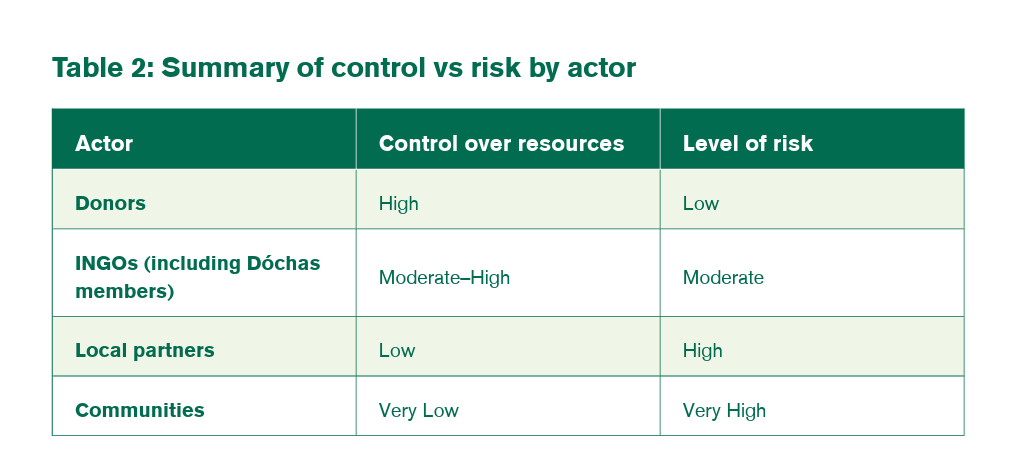
Financial and operational risks are perceived as disproportionately carried by local organisations. While partnerships are framed as collaborative, in practice risk allocation is frequently asymmetrical: donors and intermediaries retain control over resources while local partners absorb implementation and financial uncertainties.
Part II: Key Thematics - Local Partner Perspectives
This chapter presents the key themes emerging from primary evidence gathered from local partner organisations in Ethiopia, Kenya, and Uganda, as well as from the KIIs with Dóchas members and desk review of member organisation documentation. The findings are organised thematically across the core dimensions shaping progress towards LLD. Throughout, findings are presented as the perspectives of local partners, reflecting how they experience and understand their partnerships with Dóchas member organisations.
3.3 Strategy, co-creation, and programme design
Across all three countries, local partners consistently emphasise that they are best positioned to identify community needs and set development priorities due to their proximity to, and embeddedness within, communities. Effective programming should begin with local realities.
In Uganda, this connection between local knowledge and sustainability was particularly clear. Programmes grounded in locally identified priorities are more likely to be sustained beyond project cycles, because communities view them as directly relevant to their needs.
3.4 Capacity strengthening
Capacity strengthening is consistently recognised across both the desk review and primary evidence as central to advancing LLD. There is broad agreement that sustainable local leadership depends not only on technical skills, but on strong institutional systems, governance structures, and organisational resilience.
The desk review reflects the start of a shift in discourse away from transactional, short-term training towards systems-oriented capacity strengthening. Some member organisations emphasise long-term institutional resilience, while some link capacity strengthening to inclusive leadership and locally rooted governance systems.
However, primary evidence from local partners indicates that in practice, they see a lot of capacity strengthening as remaining largely externally driven and aligned with donor and INGO compliance requirements. Many initiatives focus on reporting, financial accountability, and project delivery systems rather than locally identified priorities or long-term institutional needs.
Local partners associate effective capacity strengthening with:
- increased ability to independently manage resources
- influence over programme decisions
- ability to mobilise funding
- engagement in strategic planning
- strengthened governance systems
- sustainability beyond external funding cycles
3.5 Compliance, tools, and templates
Tools, templates, compliance requirements, and due diligence processes play a significant role in shaping how local organisations engage with INGOs and donors. While these systems are intended to ensure accountability, quality assurance, and risk management, they often introduce significant administrative burdens and unintentionally reinforce power imbalances.
Local partners across all three countries acknowledge the importance of compliance and due diligence. However, these processes are often resource-intensive and disproportionately demanding, with systems largely designed around donor and INGO requirements with limited adaptation to local organisational capacities.
Standardised tools and templates can provide useful structure, but are often externally designed and may not fully reflect local realities or information needs. They are primarily geared towards donor reporting rather than local learning or adaptive management.
A key cross-cutting finding is that compliance and due diligence systems reinforce asymmetrical power relations. Local partners are required to meet stringent reporting and documentation standards to access funding, while having limited influence over the design of these systems. Compliance functions not only as an accountability mechanism but also as an instrument of control.
On the positive side, emerging practices – including ongoing feedback mechanisms between local partners and INGOs, joint review meetings, and capacity-building efforts in safeguarding and monitoring – demonstrate that when compliance systems are accompanied by capacity strengthening, dialogue, and flexibility, they can contribute to organisational development rather than simply acting as control mechanisms.
3.6 MEAL systems
Across partners in Ethiopia, Kenya, and Uganda, MEAL systems are recognised as essential for tracking progress, ensuring accountability, and informing programme improvement. However, MEAL frameworks are seen as largely shaped by donor requirements, with local partners playing a stronger role in implementation and data collection than in system design and learning utilisation.
Strong local implementation, limited influence on structure and use
Local organisations demonstrate strong capacity in implementing MEAL processes at the community level. In Kenya, structured monitoring approaches are well embedded, with organisations using pre- and post-assessments, follow-up visits, and routine monitoring to track progress. In Uganda, MEAL is closely linked to organisational credibility and accountability. However, while data is collected by partners, those partners do not have influence over how it is used to improve systems or programmes for current or future cycles.
A consistent pattern emerges: local organisations play a critical role in generating and managing data at the implementation level but have limited influence over how MEAL systems are structured and used. A recurring theme, therefore, is the perceived dominance of upward accountability within MEAL systems, often at the expense of local learning and adaptive management. Data is often collected and reported upward, with fewer mechanisms to ensure that insights are systematically fed back into programme design or community-level learning.
Emerging participatory MEAL approaches
While involvement in designing MEAL frameworks remains limited, there are emerging examples of more participatory approaches. In Kenya, feedback loops between local partners and INGOs suggest opportunities for more iterative learning and adaptation. In Uganda, partners cited capacity strengthening in monitoring systems as enabling local organisations to better manage and utilise MEAL processes. Where local partners are engaged beyond data collection, MEAL systems can become more responsive and relevant, but such practices remain inconsistent and are not yet institutionalised across the programme cycle.
3.7 The Role of INGOs and Dóchas member organisations
INGOs as enablers and connectors
Across all three countries, Dóchas member organisations and INGOs more broadly are positively perceived for their role in strengthening local capacity and providing technical expertise. In Kenya, training and knowledge transfer are perceived as enabling local organisations to implement locally relevant solutions. In Uganda, training and mentorship enable local organisations to cascade knowledge to communities and sustain interventions beyond project cycles.
INGOs are also recognised for their value as connectors. A participant in a workshop in Ethiopia highlighted how INGOs can bring together diverse local actors in a way that local organisations or even networks struggle to do. This is because they are seen as outsiders who stand apart from the internal competitive environment.
INGOs as intermediaries and gatekeepers
Despite positive contributions and improvements in equitable partnerships, INGOs are seen as continuing to function as intermediaries within the aid architecture and retaining significant control over financial resources and strategic priorities at the expense of local organisations. As mentioned, local organisations are required to meet extensive reporting and compliance requirements which, while ensuring accountability, also reinforce power imbalances within partnerships.
Across contexts, this intermediary role positions INGOs as gatekeepers of both resources and decision-making. While local partners are recognised for their proximity and contextual knowledge, they are not equally empowered to shape the direction, financing, and governance of development interventions.
Alongside discussions on the role of intermediaries, one workshop also examined how partners define ‘local’ entities. Participants argued that INGOs that establish locally registered offices, but remain strategically directed by headquarters in the Global North, cannot be regarded as local organisations.
Emerging shifts towards collaborator role
There is growing evidence, across different country contexts, of Dóchas member organisations adopting more participatory and collaborative approaches. In Kenya, partners describe increasingly reciprocal engagement processes: regular feedback mechanisms, joint planning meetings, and a sense that member organisations no longer act as ‘bosses’ but value the voice of partners and the community.
In Uganda, long-term partnerships are identified as a key enabler of more equitable collaboration. Sustained engagement over multiple project cycles allows for trust-building, improved communication, and gradual expansion of local roles.
Despite these positive shifts, co-creation remains uneven across contexts, as outlined in a number of sections above. Progress in this area will require more explicit tracking, including the extent to which local partners participate in agenda setting, lead programme design, influence resource allocation, and have access to flexible funding.
Progress in the Shift Towards LLD – A Starting Point for Measuring Change
This chapter presents a suggested menu of metrics, emerging from the data and discussions presented above. It is perhaps the most directly actionable output of this study, aimed primarily at supporting Dóchas members to move to more locally led models of development. The menu is not exhaustive, but is intended as a starting point from which members, local partners, and donors can deepen discussions – a tool to build upon in order to strengthen measurement and accountability in the shift towards LLD. It incorporates and builds on some of the metrics currently used by some members, moving further beyond traditional programme-level indicators by incorporating dimensions of power, autonomy, and system-level change – a perceived gap identified in the research. These dimensions provide a more comprehensive basis for assessing progress towards LLD, ensuring that both operational effectiveness and structural change are captured.
It is not an exhaustive table, and any indicators/means of verification employed will need to be SMART and workable.
A Menu of Metrics
This menu uses nine dimensions emerging in the discussions. Dóchas encourages members to use this as a reference point for reviewing and strengthening existing MEAL frameworks, partnership assessments, and donor reporting. Indicators are not intended to be prescriptive, and may be adapted to local contexts and used selectively based on factors such as geography, objectives, or organisation type.
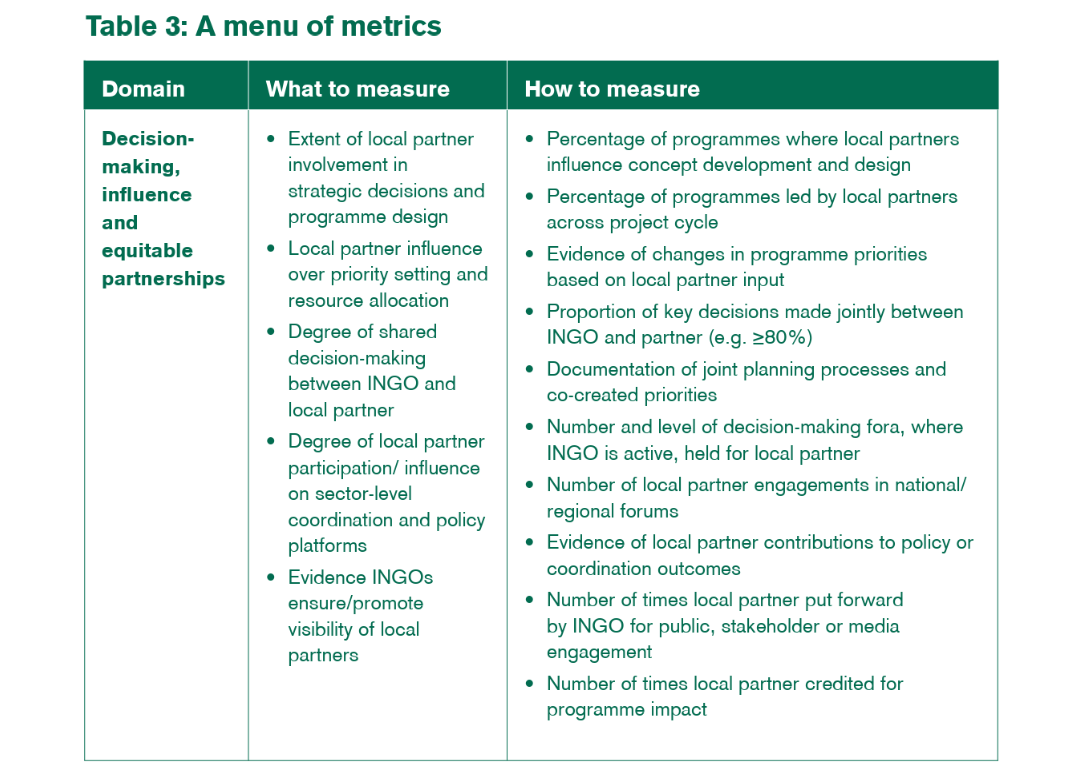
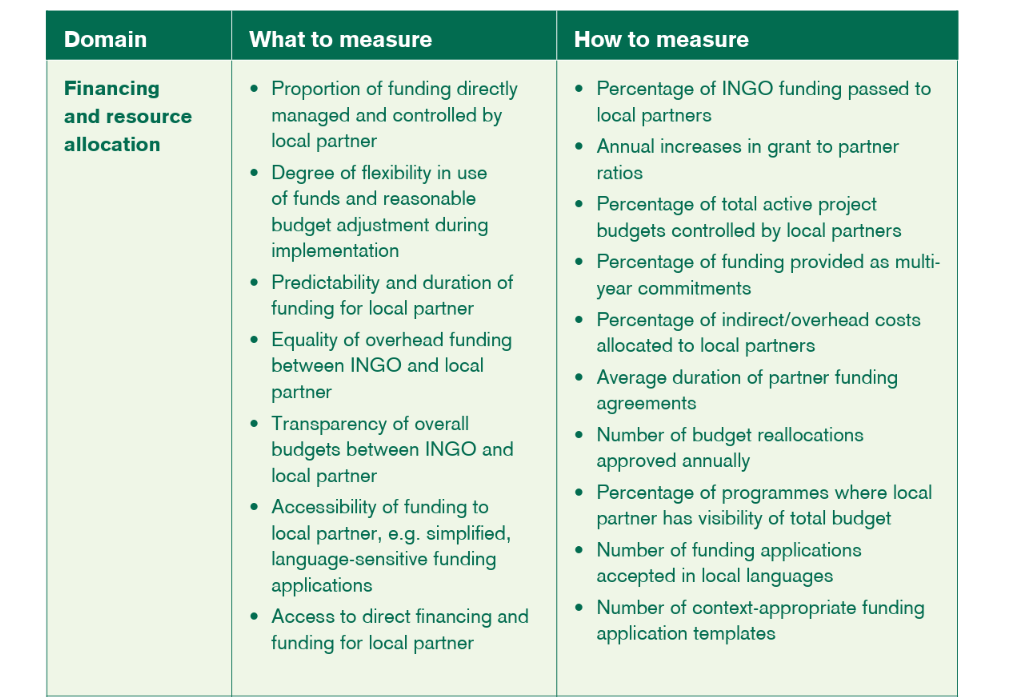

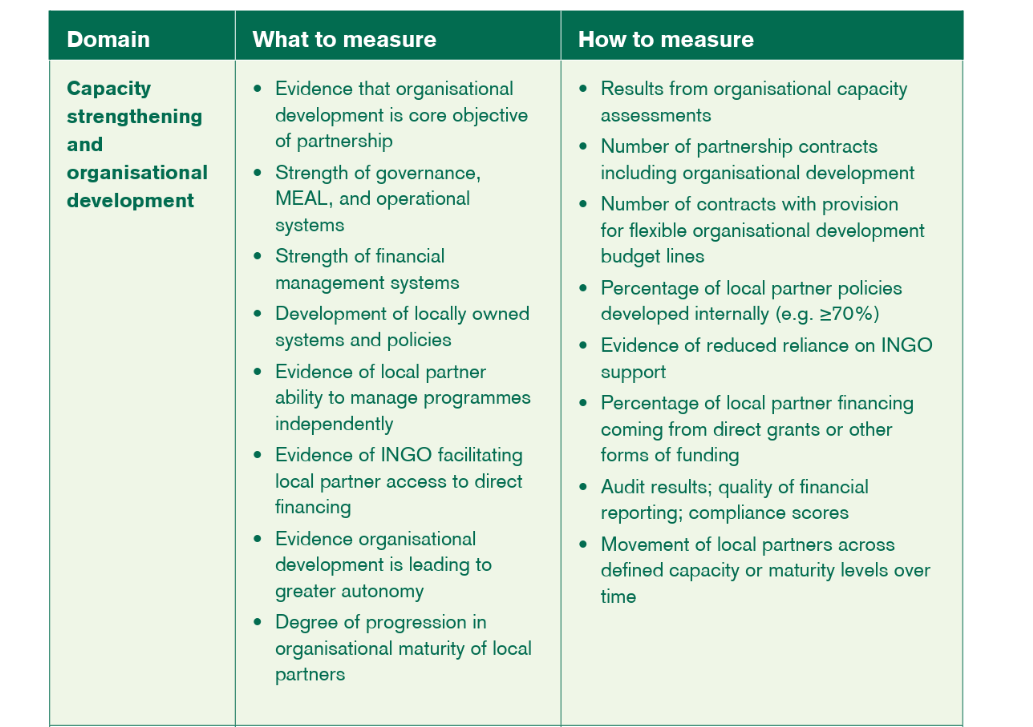
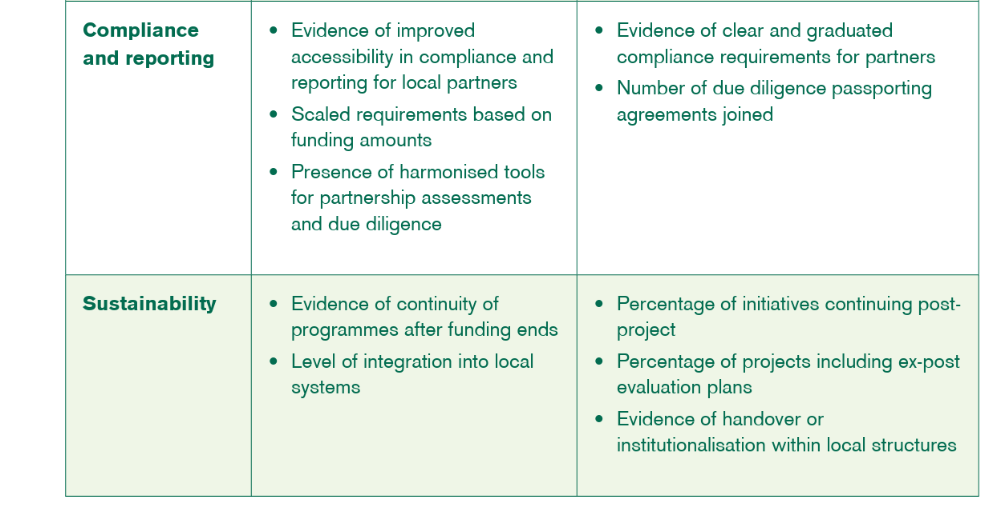
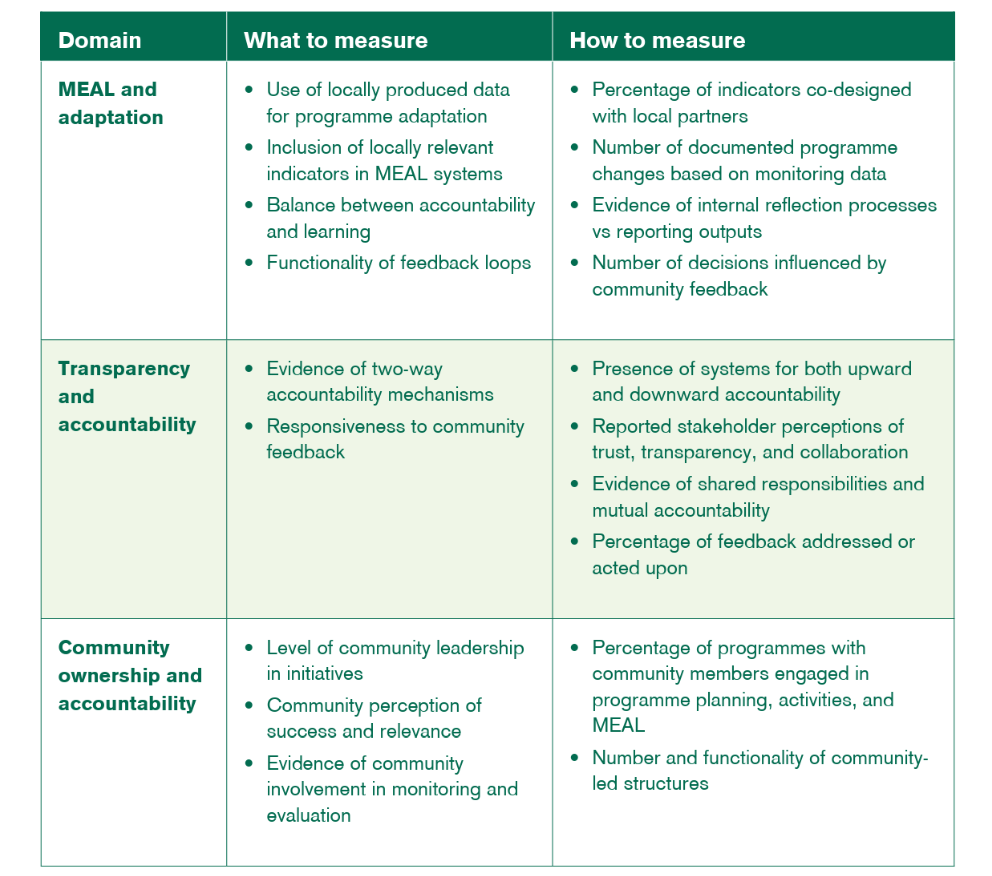
This framework should be read alongside the findings in previous sections, which provide the evidence base from which these metrics were derived.
Conclusions
The findings from this study demonstrate that LLD is increasingly recognised across the Dóchas membership as an important direction of travel, both within organisational policy frameworks and in partnership practice. Local partners across all three countries acknowledge positive shifts in engagement – particularly through stronger emphasis on participation, community engagement, inclusion, and recognition of local knowledge. There is also recognition of improvements made in flexibility and financing.
However, perspectives put forward suggest that progress towards LLD remains uneven and is generally stronger at the implementation level than at the levels of governance, financing, and strategic decision-making. Participation has expanded more rapidly than influence, creating a gap between the aspirations of LLD and the realities of partnership practice.
Local partners consistently associate genuine LLD with greater local ownership, stronger voice and influence in governance structures, more balanced transparency and accountability, greater financial autonomy, and recognition of local partners as strategic actors rather than primarily as implementers.
Other four key points are:
Local partners perceive most current funding systems as characterised by short cycles, rigid structures, complex compliance requirements often unsuited to local contexts or funding amounts, delayed disbursements, and limited direct access to resources. These arrangements reinforce dependence on intermediary structures and limit local autonomy.
Financial and operational risks are perceived as disproportionately transferred to local organisations without corresponding authority over resources or programme decisions.
While important progress has been made in the participation of women and marginalised groups within programmes and community structures, inclusion remains stronger at the community and implementation levels than within higher-level decision-making spaces.
Existing MEAL frameworks for local partners remain largely oriented towards upward accountability to donors and INGOs. In relation to LLD, few use indicators that measure more transformational shifts in equitable partnerships or accountability to communities.
By prioritising local leadership, fostering mutual accountability, investing in long-term organisation development, and embedding locally defined indicators of success within partnership and MEAL systems, both DFAT Ireland and Dóchas members can move closer to development approaches that are more responsive, equitable, locally grounded, and sustainable.
Efforts to move towards LLD will remain constrained within existing structures and accountability systems without further work on encouraging change and tracking corresponding progress.
Perspectives from local partners gathered in this study reinforce the value of measurement that includes:
- Locally informed and partnership-oriented metrics that assess relational and transformative dimensions of LLD
- Metrics that assess financial autonomy, predictability, flexibility, and local influence over budget decisions
- Metrics that assess reconfiguration of roles, responsibilities, and power across the development ecosystem, and position local CSOs not only as implementers but as coarchitects of development processes
Recommendations
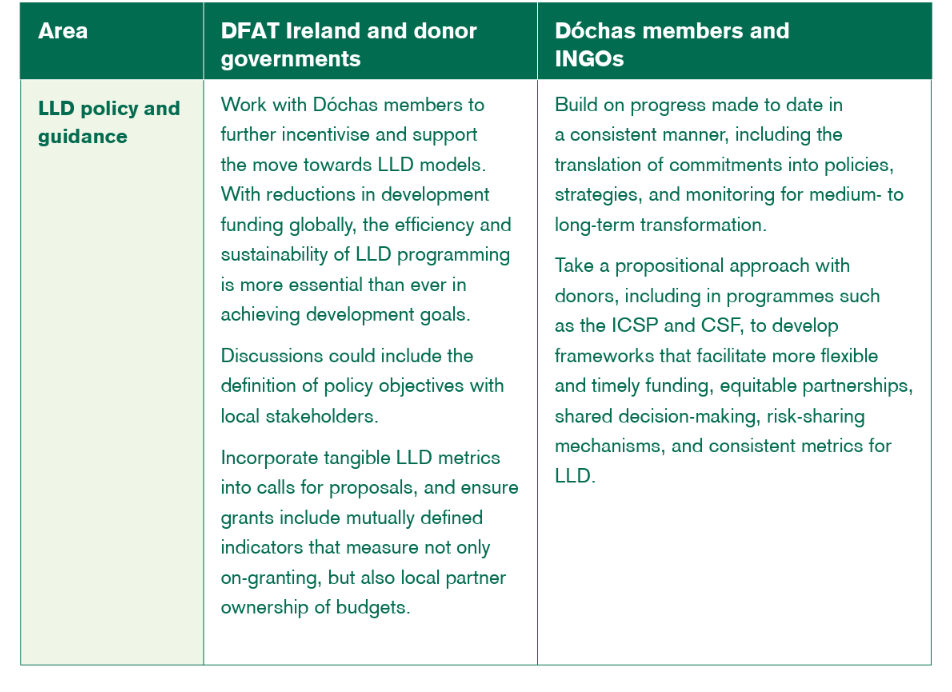
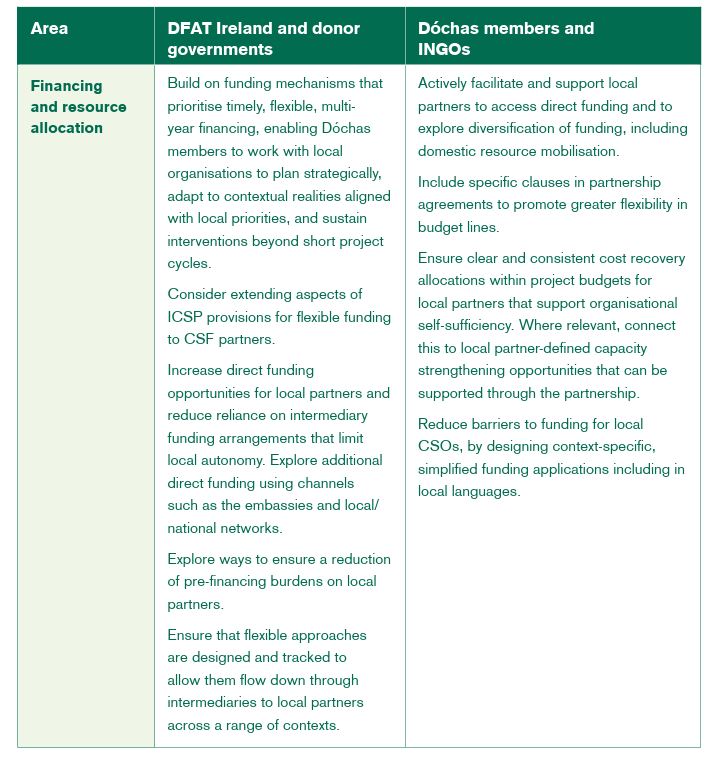
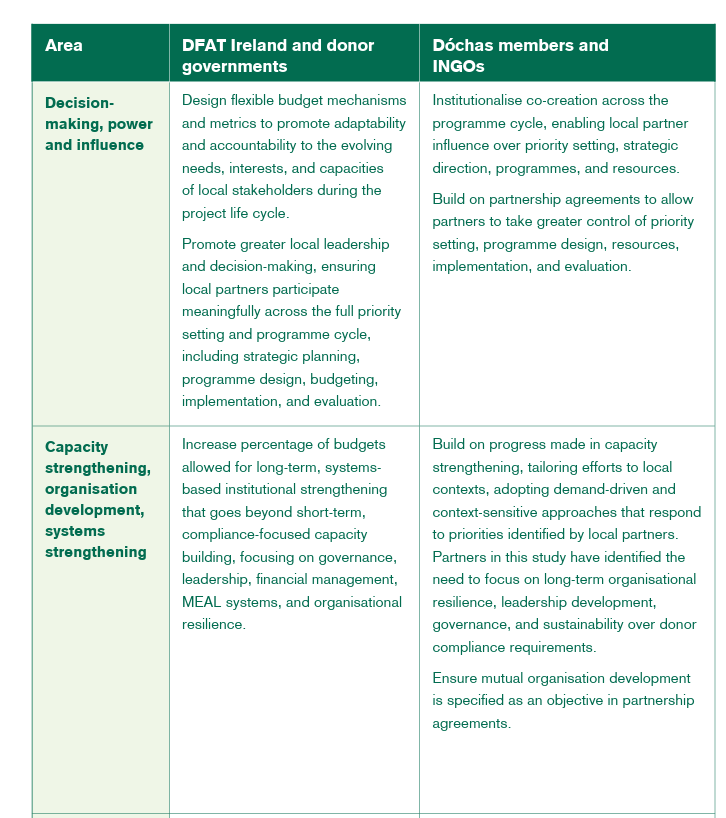
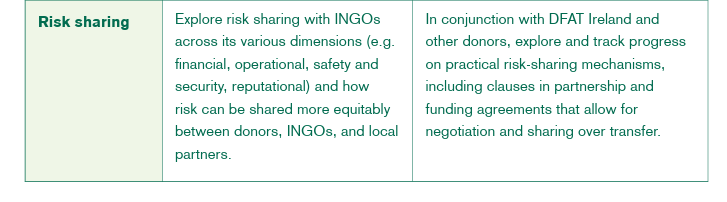
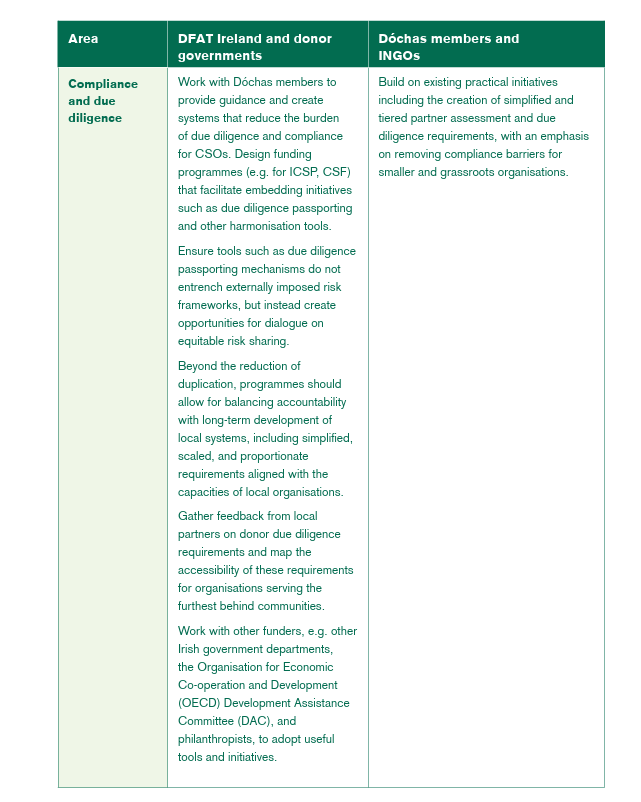
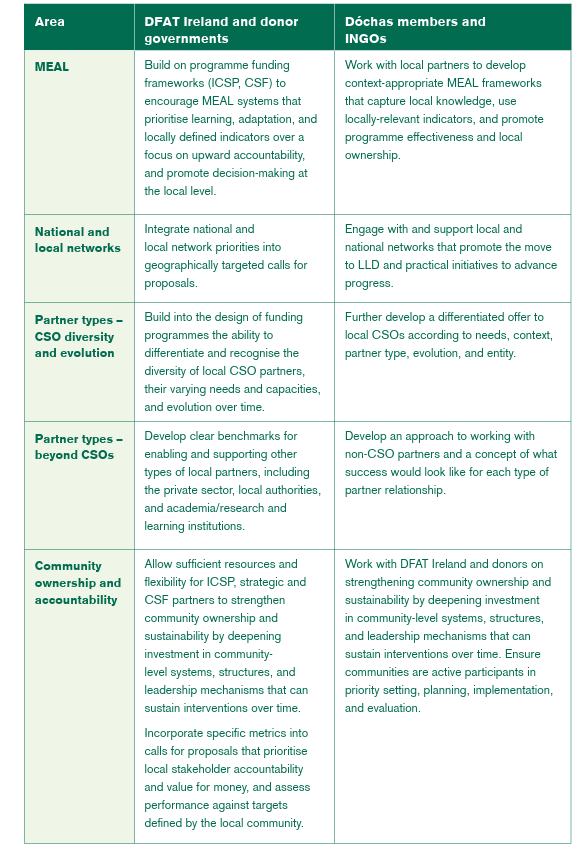
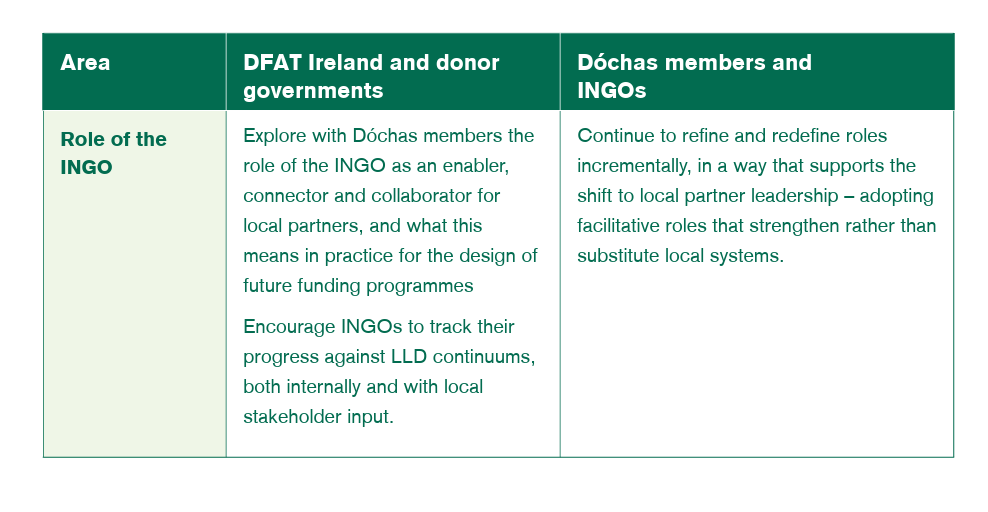
Recommendations are directed at two audiences: 1. DFAT Ireland and donor governments, and 2. Dóchas members and INGOs.
Consider the use of a range of metrics, some of which are outlined in Table 3, Chapter 4, that promote and support the shift towards LLD.
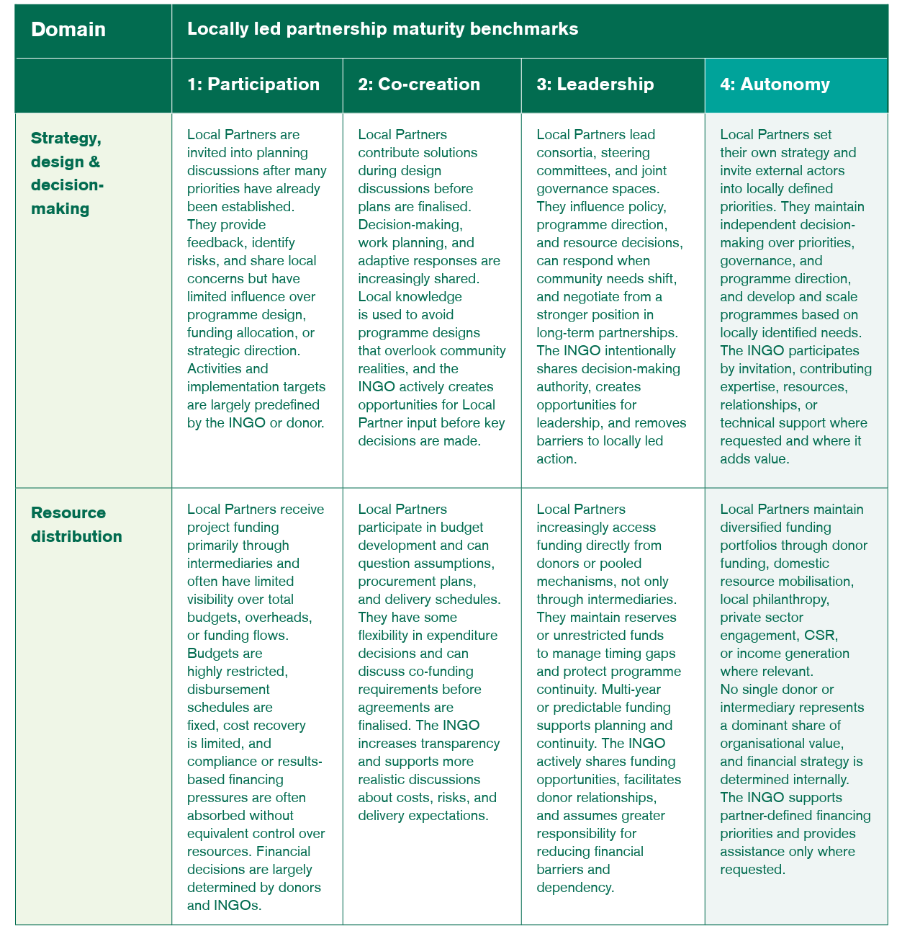
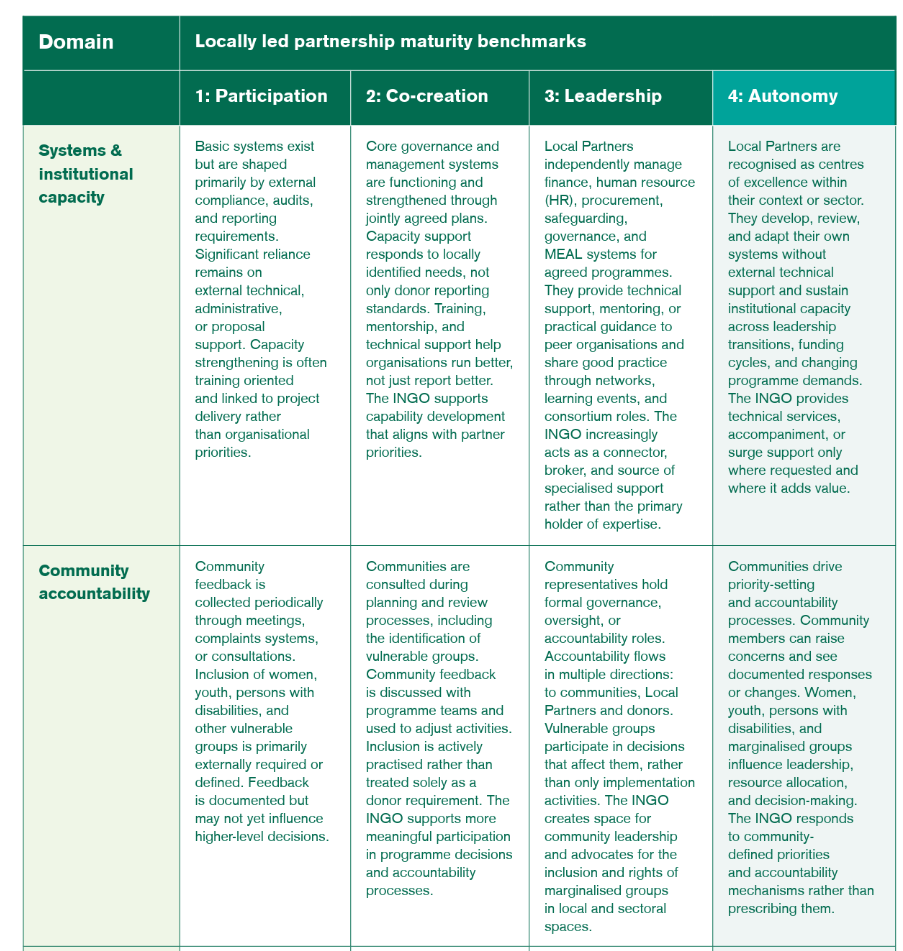
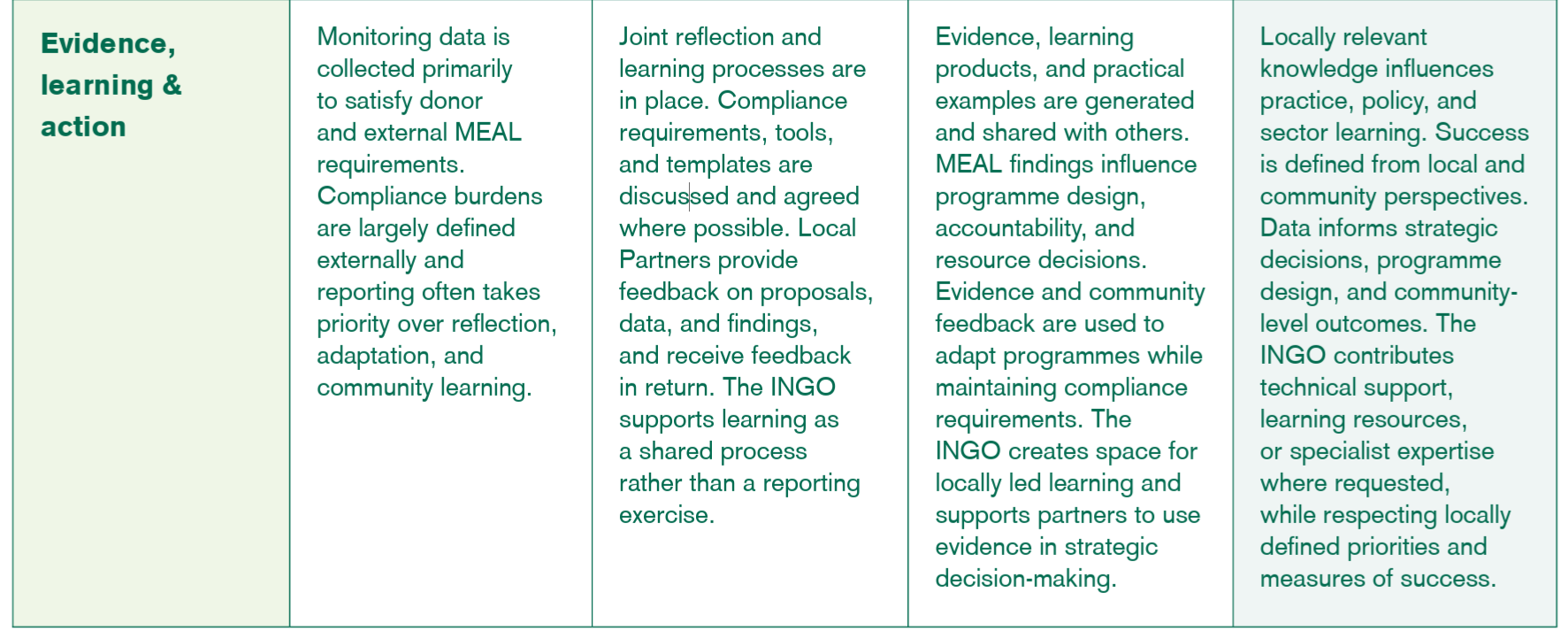
Adopt a continuum approach that supports INGOs and local partners to move through a progressive, transformational process towards full LLD. The LLD Maturity Framework in Annex 1 was developed during the project for this purpose. It is intended as a tool to support donors, Dóchas members, and other stakeholders to further strengthen efforts in moving to locally led models of development.
Table 4 outlines recommendations for each:
Locally Led Development Maturity Framework
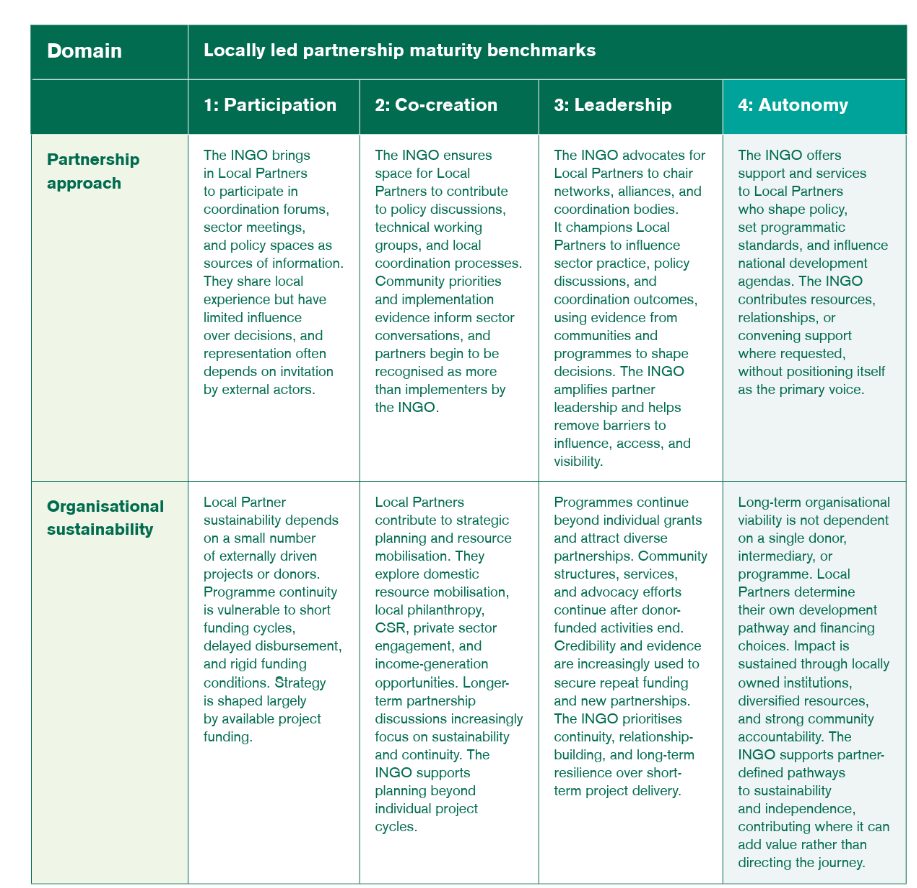
Findings from this research suggest that members and local partners see LLD as a progression that could be articulated as advancement through a number of stages of transformation.
The LLD Maturity Framework sets out four stages of progression, from participation through to autonomy, under seven domains relating to strategy, design and decision-making; resource distribution; systems and institutional capacity; community accountability; evidence, learning, and action; partnership approach; and organisational sustainability.
Methodology
Overall approach
The study adopted a qualitative and participatory methodology, grounded in participatory research principles, and designed to generate rich, contextually grounded insights rather than statistically representative findings. The research constituted a qualitative inquiry exploring the perspectives, experiences, and beliefs of local civil society partners regarding what constitutes meaningful progress towards LLD.
The study was conducted in Ethiopia, Kenya, and Uganda – countries selected both because they host a significant number of Dóchas member organisations and their local partners, and for logistical and operational reasons that made in-country consultations feasible within the scope of the assignment.
Participation in the study was voluntary, with a number of Dóchas member organisations with operations in the three countries volunteering to take part. An intentional effort was made to engage a cross-section of local partner types, including established national organisations, community-based organisations, cooperatives, and women-led structures operating across different thematic and geographic contexts. The study focused primarily on development-oriented partnerships, while recognising that in practice, the boundaries between development and humanitarian work are often fluid – particularly in contexts characterised by recurrent shocks, displacement, and livelihood insecurity.
Inception phase
The inception phase began with a kick-off meeting with Dóchas and a small steering group of members and the Secretariat to align stakeholders and clarify objectives. This was followed by a light desk review of Dóchas members’ LLD policies, relevant national frameworks, donor policies, and global best practices. Initial consultations with member organisations provided valuable input that strengthened the conceptualisation of the study. A study matrix was developed linking research objectives, questions, and methods.
Secondary data collection
A detailed and targeted desk review was undertaken to generate secondary evidence on how Dóchas members approach and measure LLD. The review focused on organisational policies, partnership frameworks, MEAL systems, donor reporting requirements, and relevant global guidance and literature on LLD. It prioritised Dóchas members with participating local partners (ActionAid Ireland, Aidlink, Brighter Communities Worldwide, Children in Crossfire, GOAL Global, Misean Cara, Self Help Africa, Sightsavers Ireland) alongside a number of organisations involved in the Dóchas LLD Working Group.
Additional inputs were obtained from Concern Worldwide, Trócaire, World Vision Ireland, and Plan International Ireland. The review process remained iterative, incorporating emerging documents and updated materials throughout the study period. Analytical frameworks used as reference tools included the DFAT Australia Locally Led Development Continuum and selected OECD frameworks. These informed analytical framing rather than serving as formal assessment benchmarks.
Primary data collection
Primary data collection included the following three elements:
Semi-structured KIIs were conducted with focal points from 11 Dóchas member organisations to capture strategic, policy, and funding perspectives on LLD. Themes included ownership, agency, power dynamics, financial sustainability, representation, governance arrangements, and accountability mechanisms.
FGDs were conducted with local partner organisations across Ethiopia, Kenya, and Uganda. A total of 28 local partner organisations were engaged, with each FGD comprising 4–6 participants primarily from senior management, programme staff, and MEAL units. One FGD was organised per local partner – partners were not brought together in shared sessions – so that issues could be discussed contextually and to preserve confidentiality. Discussions explored practical experiences of LLD, including decision-making processes, access to and control of resources, financial sustainability, and representation within partnerships.
In-person workshops were conducted in each of the three countries to deepen engagement with local partners and validate emerging findings. These workshops brought together diverse local partners who had participated in FGDs, and applied participatory tools to co-develop contextually relevant success factors and indicators.
Data quality, ethics, analysis and anonymity
All FGDs and KIIs were held virtually. Interviews were recorded with participant consent to support accurate transcription and analysis. Transcripts were translated where necessary, anonymised, and systematically compiled. Data was securely managed using encrypted digital platforms with access restricted to authorised team members.
Thematic analysis was applied to identify recurring patterns, perspectives, and experiences. Comparative analysis examined similarities and differences across countries and organisational types. Qualitative data from the desk review and primary consultations were triangulated to strengthen credibility and analytical depth.
All stages of the assignment were conducted in line with high ethical and safeguarding standards, prioritising informed consent, confidentiality, inclusivity, and participant well-being. The approach was aligned with the IASC (2023) Guidance on Participation and Localisation, OECD Development Assistance Committee standards, and the Dóchas Code of Conduct.
Quality assurance was overseen by the Steering Committee, comprising representatives from Dóchas, Self Help Africa, and Children in Crossfire. Double-coding was applied to qualitative data analysis to enhance consistency and reduce bias.